Iran Deal Rumors Become Real: WTI Slides Another 6%, Dow Hits New High
Tehran's pledge to reopen the Strait of Hormuz hammered crude for the second straight session — but the same news sent the Dow to a record as capital rotated hard into consumer and industrial names.

TL;DR
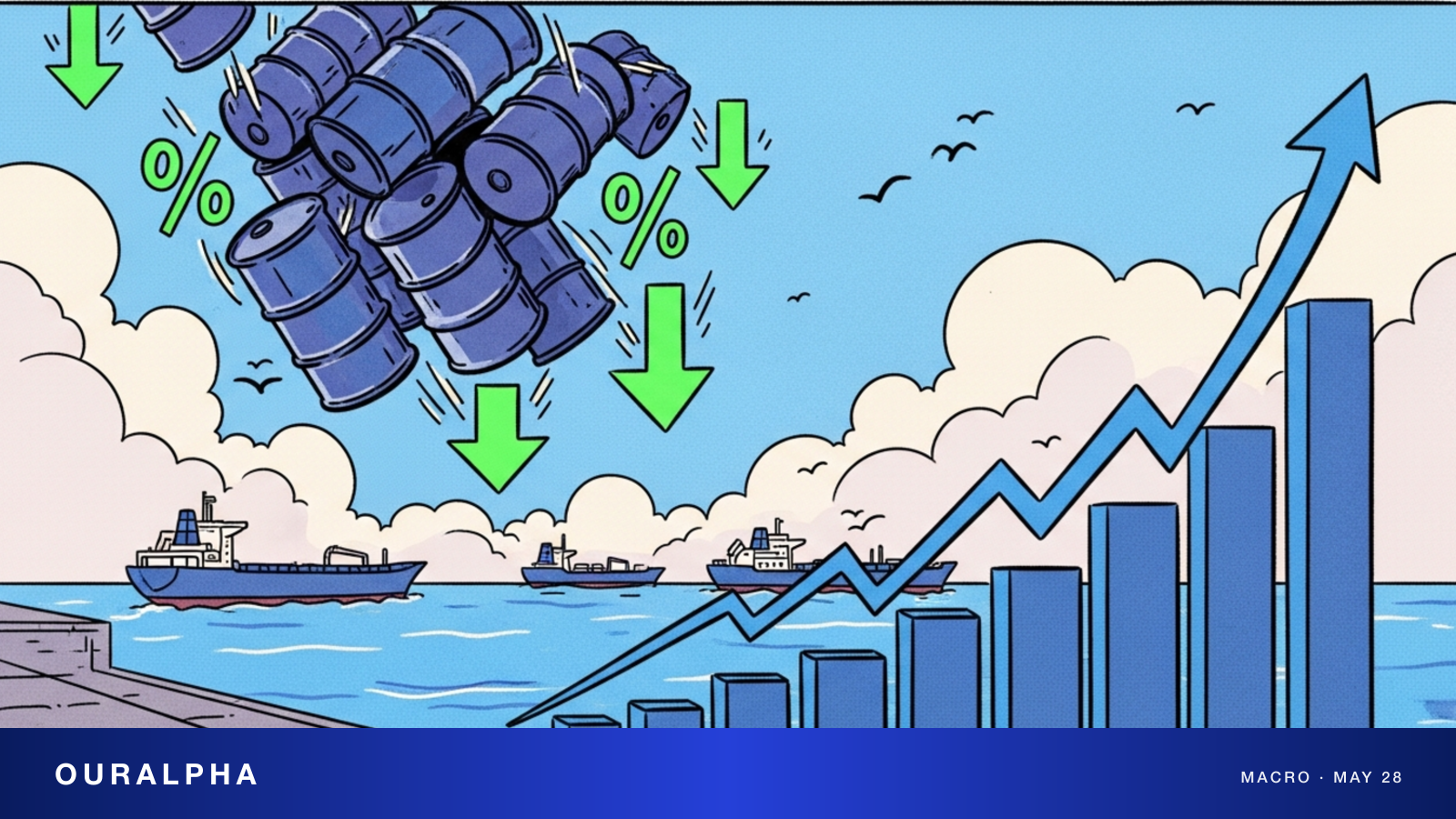
On 5/25 we wrote that WTI's 4% drop was "pricing down tail-risk probability" — not pricing in a done deal. By the 5/27 morning session, multiple outlets confirmed Tehran will restore commercial transit through the Strait of Hormuz as part of a US-Iran framework agreement. WTI fell another 6% on the day. At the same time, the Dow added 200 points to a new all-time high, the S&P 500 closed at 7,546 (+0.36%), and the Nasdaq Composite slipped -0.3% — a textbook "peace trade + defensive rotation" divergence.
- WTI -6% on the day; cumulative two-session loss approaching -10%; Brent followed lower
- Dow +200 pts (new ATH) / S&P 500 7,546 (+0.36%) / Nasdaq -0.3% — unusual divergence
- Sector rotation: consumer staples + industrials + airlines led; energy (XLE) + cybersecurity (BUG ETF -5%) lagged
- Key signal: Friday's PCE print — how it reflects the energy cost release will shape the June FOMC rate-path narrative
On 5/25 we argued that WTI's single-day 4% drop was pricing down worst-case probabilities, not a signed deal. The 5/27 session validated that read — multiple outlets reported during morning trading that Tehran will restore commercial shipping through the Strait of Hormuz as part of a US-Iran framework agreement. WTI fell another ~6% on the day, bringing the two-session cumulative loss to nearly 10%. Brent moved in lockstep.
This wasn't a holiday thin-market quirk. This was a sustained selloff across a full US trading session — meaning real money is genuinely stripping the geopolitical risk premium out of the energy complex.
How the Dow Hit a Record While Oil Crashed
On the same day, the Dow Jones Industrial Average gained 200 points to a new all-time high; the S&P 500 closed at 7,546 (+0.36%); the Nasdaq Composite fell -0.3%. That "Dow strong / Nasdaq weak" setup has been almost nonexistent over the past 18 months — the dominant narrative has been Mag 7 and AI capex, with the Dow's heavier weighting toward industrials, consumer staples, and healthcare leaving it a perennial underperformer.
Three things drove the reversal:
First, Procter & Gamble (PG) +3% and Home Depot (HD) +2% led the Dow. Consumer staples and home improvement are acutely sensitive to oil — fuel and logistics are meaningful cost-structure variables for both. WTI -6% in a day feeds directly into modest upward revisions to 2026 consensus EPS models.
Second, airlines and freight caught a bid. Carriers like Delta (DAL), United (UAL), and FedEx (FDX) — where fuel runs 20–30% of total revenue — stand to see roughly $1 billion in annualized fuel-cost relief for every sustained $5 decline in WTI.
Third, the Nasdaq's weakness wasn't Mag 7 — it was cybersecurity imploding. Zscaler (ZS) cratered 30%+ after a guidance miss, dragging Palo Alto Networks (PANW) and CrowdStrike (CRWD) with it. The cybersecurity ETF (BUG) fell more than 5%, erasing most of the Nasdaq's would-be gains for the session.
Where Capital Is Moving
Stack those three together and the picture is clear: 5/27 was a classic "peace trade plus defensive rotation" session.
Energy into transport and consumer. That's a direct trade — lower crude, lower input costs, higher margins.
High-multiple SaaS into Dow blue chips. This one is subtler. Zscaler's blowup forced a fresh look at the safety margin in SaaS valuations. When names like ZS, PANW, and CRWD — inflated by the AI-security narrative over the past year — start missing guidance, the obvious question is whether to rotate into cheaper, more predictable cash flows. Dow blue chips are the answer.
Mag 7 and AI semis neither crashed nor led. Nvidia (NVDA), Apple (AAPL), and Microsoft (MSFT) were all soft on the day. NVDA has pulled back 9.5% over six sessions from its all-time high of $236.54 on 5/14, sitting at $213.95. The rotation from Mag 7 into infrastructure — Micron (MU) surged 19% on 5/26, Vistra (VST) staying strong, CoreWeave (CRWV) among others — continues.
Friday's PCE Is the Real Test
Lower oil, a Dow record, Nasdaq lagging — whether this combination holds depends on one thing: whether Friday's April PCE report reflects the energy cost relief.
If both headline and core come in soft — core PCE MoM at +0.15% or below — the June FOMC rate-path narrative gets reshuffled. Markets could start pricing a July cut instead of September. That would be another tailwind for Dow blue chips and rate-sensitive growth names alike.
If PCE runs hot — sticky services inflation offsetting the energy softness — the "peace trade" thesis gets challenged and the Dow's new high could mark a near-term top.
Three signals to watch this week:
1. WTI spot closes Wednesday, Thursday, and Friday. A sustained hold below $90 would cement the view that the geopolitical premium has been fully unwound. A snap back above $95 signals the market is questioning whether the deal actually gets implemented.
2. Dow vs. Nasdaq relative performance. If the Dow outperforms the Nasdaq for three-plus consecutive sessions, the rotation is real. If it reverses the next day, it was noise driven by the Zscaler event — not a structural shift.
3. The 2-year Treasury yield after the PCE print. The 2-year is the cleanest real-time gauge of rate-path expectations. A break below 4.0% effectively prices in a September — or earlier — cut.
Sources
- Dow jumps nearly 300 points to hit new record as oil prices retreat — CNBC
- Stock Market Today May 27 2026: Iran Deal Murmurs + Chip Sector Rally — TheStreet
- US-Iran Framework Targets Strait of Hormuz Disruption Risk — Reuters
- U.S. Crude Oil and Petroleum Data — EIA
- Personal Consumption Expenditures Price Index — BEA
This content is for informational purposes only and does not constitute investment advice, trading advice, or any guarantee of returns.