Nvidia, Dell and Broadcom all confirmed AI demand—the stocks are trading the quality of the beat
Three recent updates show demand expanding across accelerators, systems, networking and custom silicon. The market is now distinguishing growth from expectation-adjusted growth.

Thesis signal: The AI capex cycle remains intact, but future winners need to show breadth, margin and conversion—not only backlog.
Key points
- Nvidia reported 117% Data Center growth.
- Dell described accelerating enterprise AI adoption and more than 6,500 AI Factory customers.
- Broadcom reported 221% AI semiconductor growth but fell as guidance met a higher expectations bar.
The one-line thesis
The latest results from Nvidia, Dell and Broadcom point in the same fundamental direction: demand for AI infrastructure is still expanding. Their stock reactions differ because each sits at a different point in the expectation cycle. Nvidia’s platform leadership, Dell’s system integration and Broadcom’s custom silicon and networking all benefit from the buildout, but the market increasingly rewards evidence that converts demand into durable margin and cash.
Three layers of the same buildout
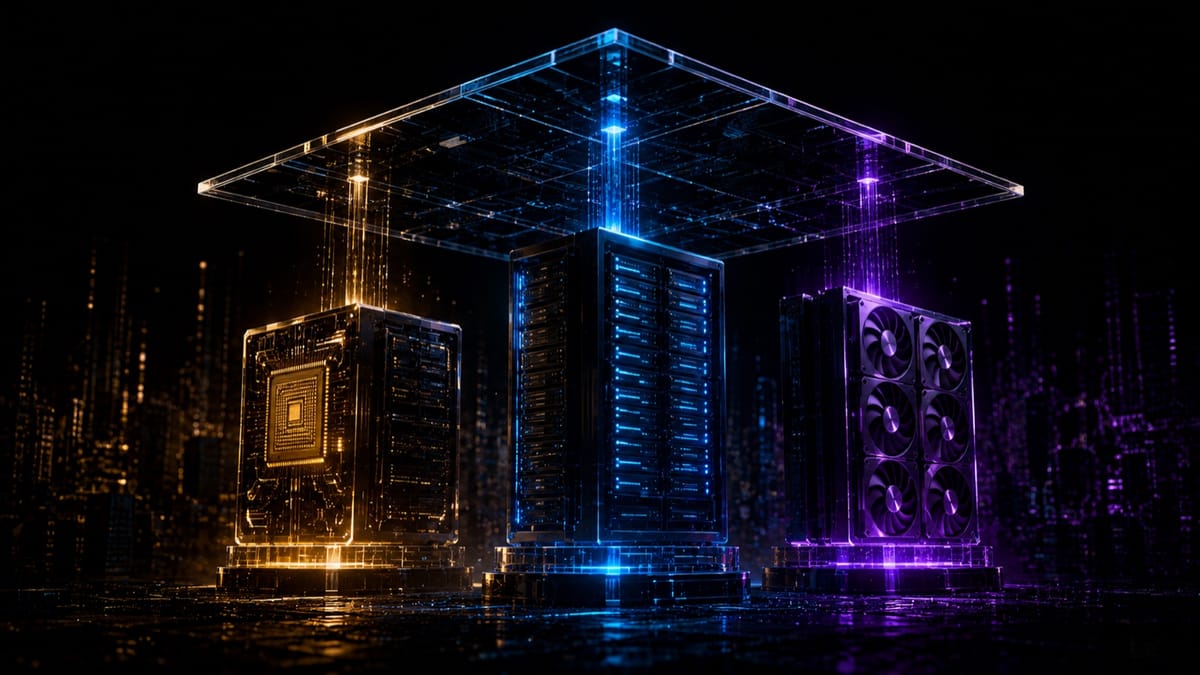
Nvidia captures accelerator, networking and software economics. Broadcom supplies custom accelerators and connectivity for large customers. Dell integrates accelerators, servers, storage, networking and services into systems that enterprises can deploy. The companies are not interchangeable, but together they provide a useful map of the AI capital chain. Strength across all three reduces the chance that one supplier’s growth is merely share shift.
Nvidia confirms the size of compute demand
Nvidia’s $89.0 billion of quarterly Data Center revenue shows that accelerator demand continues to scale at extraordinary speed. The company’s ecosystem and roadmap give it visibility across hyperscalers, labs, sovereign projects and enterprises. The key risk is the base effect: triple-digit growth becomes harder to maintain as revenue approaches a scale that would have represented the entire market only a few years ago.
Dell confirms distribution beyond the frontier
Dell’s disclosure of more than 6,500 AI Factory customers provides evidence that adoption is moving beyond a limited set of frontier buyers. Enterprise growth matters because it can create repeatable demand for complete systems and services. The trade-off is margin and timing: enterprise projects are diverse, component supply is tight and revenue can move between quarters as systems are configured and accepted.
Broadcom confirms custom silicon and networking
Broadcom’s $16.7 billion of AI semiconductor revenue demonstrates that custom accelerator programs are becoming a second major compute lane. Its networking exposure benefits across architectures. Yet the weaker share reaction after guidance illustrates the expectations problem. The business can accelerate and the stock can still fall when the market has already priced an even larger beat.
What the combined evidence says
The cycle is broader than a single chip and deeper than a single customer type. Demand spans compute, networking, systems, power and software. That breadth supports the industry thesis, but it also raises capital intensity across the ecosystem. Investors need to distinguish revenue captured by asset-light platform suppliers from revenue that requires working capital, inventory and facility investment.
The quality framework
Judge each company on four dimensions: customer breadth, backlog conversion, incremental margin and free cash flow. Customer breadth reduces concentration. Conversion shows that orders become usable systems. Incremental margin reveals pricing power, while free cash flow tests whether growth is financed by customers or by the supplier. A company can lead on one dimension and lag on another, which is why the same demand cycle produces different valuation outcomes.
What could end the cycle
A broad slowdown would likely appear first in customer deployment schedules and utilization, then in orders and supplier revenue. Custom silicon could redistribute share without reducing total spending, while power constraints could delay the entire stack. The negative scenario is not one disappointing guide. It is simultaneous weakening in accelerator demand, system orders, networking growth and cloud utilization.
Avoiding double counting
Industry revenue can be counted repeatedly as it moves through the chain. A hyperscaler’s capital expenditure becomes revenue for a server assembler, which purchases accelerators and networking from other suppliers. Adding every company’s AI number does not measure final demand. Investors should trace spending to the customer workload and identify which company retains margin at each layer. The strongest growth does not always sit where the largest gross order value is reported.
Power is the common constraint
All three companies ultimately depend on powered data-center capacity. Nvidia and Broadcom can produce silicon faster than some customers can energize sites, while Dell must deliver complete systems into those facilities. That common dependency can create correlated timing risk even when order books remain healthy. Monitoring utility interconnections, rack density, cooling and project milestones adds an essential physical layer to the earnings analysis.
Scenario map
In the upside case, AI workloads monetize quickly, customer capex remains high and every layer converts demand with stable margin. In the base case, spending persists but value rotates between accelerators, custom silicon, networking and systems. In the downside case, customers slow deployments as utilization and returns disappoint, creating simultaneous order and margin pressure. The transition from rotation to cycle break would require weakness across several layers, not a decline in one stock.
Cross-company checklist
For Nvidia, track Data Center revenue, networking and gross margin. For Broadcom, track AI semiconductor revenue, custom-program breadth and free cash flow. For Dell, track orders, shipments, backlog, customer count and Infrastructure Solutions Group margin. Add hyperscaler capex and cloud revenue as the customer-side check. When these measures move together, the cycle is coherent. Divergence helps identify whether the change reflects share, timing, pricing or actual end demand.
Bottom line
Today’s evidence argues against an immediate AI-capex collapse. Nvidia, Dell and Broadcom each reported a different expression of strong demand. The investment challenge has become more demanding: the market will not reward every beneficiary equally, and exceptional growth must now be measured against exceptional expectations. The next winners will be the companies that turn breadth into cash while keeping deployment risk under control.
Sources
This content is for informational purposes only and does not constitute investment advice, trading advice, or any guarantee of returns.