
What Is a US Stock Margin Account? Margin Trading Risks and Rules Explained
A margin account lets you borrow money to trade stocks, but losses can exceed your principal. Understand margin rules, margin calls, and forced liquidation risks.

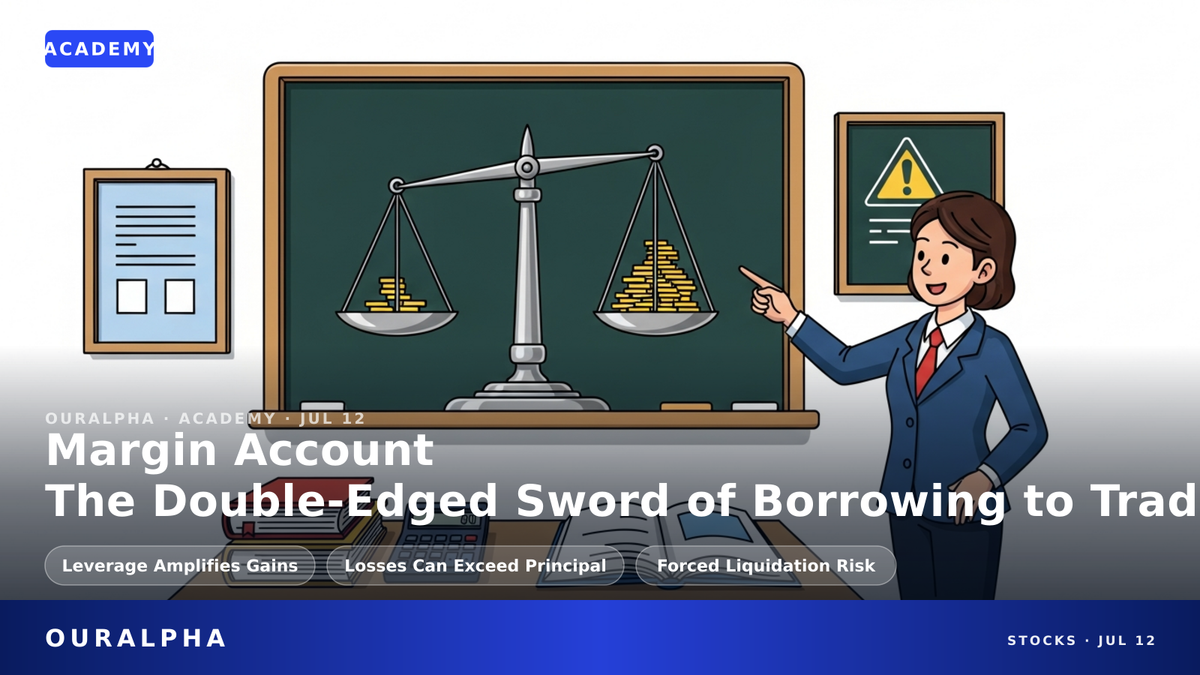
What Is a Margin Account?
Borrowing to Trade Stocks Could Leave You Owing Your Broker
Many beginners think a margin account is just a regular account that lets you borrow money to buy stocks.
But they don't realize that if your equity drops below the maintenance margin, your broker can force-liquidate your positions without notice and regardless of market timing.
Your losses can exceed your original investment, and you could even end up owing your broker money — this is the most fundamental difference between margin and cash accounts.
TL;DR · IN SHORT
- A margin account lets you borrow money to trade stocks, but losses can exceed your initial investment.
- When your account equity falls below the maintenance margin requirement (25%), a margin call is triggered, and your broker can force-sell your securities.
- Leverage amplifies both gains and losses, and interest costs eat into your returns.
KEY TERMS
Margin Account: A type of brokerage account where the broker allows you to borrow money to buy more securities, using the cash and securities in your account as collateral.
Initial Margin: Under Regulation T, you can borrow up to 50% of the purchase price of a security, meaning you must put up at least 50% of your own money.
Maintenance Margin: FINRA requires that your account equity never fall below 25% of the market value of long positions (30% for short positions). If it does, a margin call is triggered.
Margin Call: When your account equity drops below the maintenance margin, your broker demands that you deposit additional cash or securities, or it will force-sell your positions.
CONTENTS
- What's the Difference Between a Margin Account and a Cash Account?
- How Much Money Do You Need to Open a Margin Account?
- What Is Maintenance Margin and What Happens If You Fall Below It?
- Can Losses on Margin Exceed Your Initial Investment?
- How Is Margin Interest Calculated?
- Can You Use a Margin Account to Short Stocks?
- What Changes to the PDT Rule in 2026?
- FAQ
What's the Difference Between a Margin Account and a Cash Account?
Simply put, a cash account is like paying with cash — you need to have the money before you buy. A margin account is like using a credit card or taking out a loan — you can borrow money from your broker, using the cash and stocks in your account as collateral, to buy more securities.[1] Think of a cash account as "cash on delivery" — no leverage, risk is manageable. A margin account is like "borrowing a chicken to lay eggs" — you use someone else's money to amplify your investing power, but you also take on much greater risk.
For example: You want to buy $10,000 worth of stock. In a cash account, you must have $10,000 in cash to make the purchase. But in a margin account, under the Federal Reserve's Regulation T, you can borrow up to 50%, meaning you put up $5,000 of your own money and your broker lends you $5,000, allowing you to buy the $10,000 worth of stock.[3] That's leverage — using less of your own money to control a larger position. But note: this 50% is the regulatory minimum; your broker may require you to put up more, such as 60% or 70%.
Common misconception: Some people think the money in a margin account is free. It's not. You pay interest on the borrowed money, and if the stock falls, you lose your own money and still have to repay the loan. So margin accounts are best suited for experienced investors who can handle higher risk.
How Much Money Do You Need to Open a Margin Account?
Under FINRA rules, before opening a margin account, you must deposit at least $2,000 in cash or 100% of the purchase price of the securities (whichever is less).[2] So the minimum threshold is $2,000. However, some brokers may require a higher initial deposit — check their specific rules. For example, if you only want to buy $1,500 worth of stock, you only need to deposit $1,500. But if you want to buy $5,000 worth of stock, the minimum is still $2,000 because $2,000 is less than $5,000.
This $2,000 is the regulatory minimum, but many brokers actually require more, such as $2,500 or $5,000. Also, the $2,000 must be in cash or eligible securities — it cannot be borrowed money.
What Is Maintenance Margin and What Happens If You Fall Below It?
Maintenance margin is the minimum equity percentage you must always maintain in your account after buying stocks on margin. FINRA Rule 4210 requires that for long stock positions, the maintenance margin is 25% of the market value (30% for short positions).[4][5] Many brokers set a higher requirement, such as 30%–40%. Think of it like a mortgage: the bank requires your home equity to stay above a certain level, or they'll ask you to put in more money.
Example: You put in $5,000 of your own money, borrow $5,000, and buy $10,000 worth of stock. If the stock price falls and the market value drops to $8,000, your account equity (your own money) becomes $3,000 ($8,000 – $5,000). The 25% maintenance margin requires equity of at least $8,000 × 25% = $2,000. You have $3,000, so you're safe. But if the stock falls to $6,000, your equity is only $1,000, and the maintenance margin requirement is $6,000 × 25% = $1,500. You now have a $500 margin deficiency.
If the stock price drops so that your account equity falls below this percentage, a "margin deficiency" occurs. Your broker will issue a margin call, requiring you to deposit more cash or securities, or sell some positions to cover the shortfall.[6] Brokers typically give you 2 to 5 business days to meet the call, but this is not guaranteed.
Key risk: Your broker has the right to sell securities in your account without notifying you in advance to meet the margin call. Even if the broker gives you a deadline, it can still force-liquidate your positions at any time to protect itself.[7] Moreover, you cannot specify which stocks to sell, nor can you ask for an extension — the decision is entirely up to the broker.[8] This means if you don't add funds in time, the broker may sell your stocks at the worst possible moment, causing even greater losses.
Additionally, your broker can raise its own "house" maintenance margin requirement at any time without prior notice, which may be higher than the regulatory minimum of 25%. This means even if you comply with the regulatory rules, you could still be subject to a margin call.[14] For example, a broker normally requires 30%, but during volatile markets, it might suddenly raise it to 40%, and your account equity must then meet that higher threshold.
Can Losses on Margin Exceed Your Initial Investment?
Yes, and this is the biggest risk of a margin account. If the stock you bought on margin drops sharply, you could lose not only your entire principal but also owe your broker money.[9] This is called a "negative equity" or "deficit balance."
Example: You put in $5,000, borrow $5,000, and buy $10,000 worth of stock. If the stock drops 60%, the market value becomes $4,000. After selling, you get $4,000, but you owe the broker $5,000 plus interest. You've lost your entire $5,000 principal and still owe the broker over $1,000. This is a negative equity — losses exceed your principal. Even if the stock goes to $0, you still have to repay the borrowed money and interest.
So when using margin, always set stop-losses or control your position size to avoid such extreme scenarios. Also, the broker may force-liquidate before the stock hits zero, but the liquidation price could be terrible, leaving you still in debt.
How Is Margin Interest Calculated?
Borrowing money costs interest. Margin loan interest is calculated daily on the borrowed amount, and the rate is usually based on the broker's benchmark rate (e.g., the federal funds rate plus a few percentage points).[10] This means your holdings must first outperform the interest cost before you can truly profit. Interest directly eats into your investment returns, so the cost of leverage cannot be ignored.
Example: You borrow $5,000 at an annual interest rate of 8%. The daily interest is about $5,000 × 8% ÷ 365 ≈ $1.10. If you hold for 30 days, the interest is about $33. If your stock only rises 1%, or $100, after deducting interest you only make $67. If the stock doesn't move at all, you still owe interest. So using margin has a high time cost and is not suitable for long-term holding.
Can You Use a Margin Account to Short Stocks?
Yes. A margin account is a prerequisite for short selling. When shorting, the maintenance margin requirement is stricter: for stocks priced at $5 or more, it's the greater of $5 per share or 30% of market value; for stocks under $5, it's the greater of $2.50 per share or 100% of market value.[5] For example, you short 100 shares at $10, total market value $1,000. The "$5 per share" calculation is $5 × 100 = $500; the "30% of market value" is $1,000 × 30% = $300. The greater is $500, so your maintenance margin requirement is $500. If the stock rises to $15, market value becomes $1,500, the "$5 per share" is still $500, and "30% of market value" becomes $1,500 × 30% = $450. The greater is still $500, but your unrealized loss on the short is growing, and your account equity may no longer cover the $500 requirement.
For more details on short selling, see our other article: What Is Short Selling in US Stocks.
What Changes to the PDT Rule in 2026?
Previously, the Pattern Day Trader (PDT) rule required accounts that made four or more day trades within five business days to maintain at least $25,000 in equity in a margin account. But starting June 4, 2026, FINRA replaces the PDT rule with new "day-trading margin standards." The PDT label and the $25,000 minimum are eliminated, and the minimum equity requirement drops to $2,000, the same as for regular margin accounts.[12] Member brokers can phase in the changes, with full compliance required by October 20, 2027. This is a major change for day traders.
In short, previously you needed $25,000 to day trade frequently; now you only need $2,000, significantly lowering the barrier. However, the new rules may have other requirements, such as higher day-trading margin rates, so check with your broker.
常见问题 FAQ
Is it cost-effective to hold margin positions for the long term?
Usually not. Margin loan interest accrues daily, so the longer you hold, the more interest accumulates. Your holdings must first outperform the interest cost to truly profit, making margin more suitable for short-term trading than long-term holding.[10]
After receiving a margin call, what is the latest deadline to add funds?
There is no fixed time. Brokers usually set a deadline (e.g., 2–5 days), but they have the right to force-liquidate at any time before that deadline without notice.[7]
Can a margin call affect the stocks I already own?
Yes. If a price drop triggers a margin call, your broker may force-sell any securities in your account, including those you bought with your own cash, not just the ones bought on margin.[8]
Can a cash account receive a margin call?
No. Cash accounts have no borrowing leverage, so there is no maintenance margin issue and no forced liquidation.[11]
Can a broker's own maintenance margin requirement be higher than the regulatory 25%?
Yes, and it's common. This is the broker's own risk management policy, not a regulatory standard. It can be raised at any time without notice, so investors should know their broker's specific maintenance margin requirement and not rely solely on the 25% regulatory minimum.[14]
Is a margin account suitable for beginners?
No. Margin accounts carry extremely high risk, and losses can exceed your principal. Beginners should start with a cash account and get familiar with the market before considering leverage.
SOURCES
[1] SEC Investor.gov: Investor Bulletin - Understanding Margin Accounts
[2] SEC Investor.gov: Investor Bulletin - Understanding Margin Accounts
[3] FINRA: Margin Regulation
[4] FINRA Rule 4210: Margin Requirements
[5] FINRA Rule 4210: Margin Requirements
[6] FINRA: Margin Accounts
[7] FINRA Margin Disclosure Statement (Rule 2264)
[8] FINRA Margin Disclosure Statement (Rule 2264)
[9] SEC Investor.gov: Investor Bulletin - Understanding Margin Accounts
[10] SEC Investor.gov: Investor Bulletin - Interested in Margin? Understand Interest.
[11] FINRA: Margin Accounts
[12] FINRA Regulatory Notice 26-10
[13] SEC Investor.gov: Investor Bulletin - Understanding Margin Accounts
[14] FINRA Margin Disclosure Statement (Rule 2264)
This content is for informational purposes only and does not constitute investment advice, trading advice, or any guarantee of returns.